
Syncing & indexing
What mirrors automatically, what your team chooses to publish, and where Credits are spent.
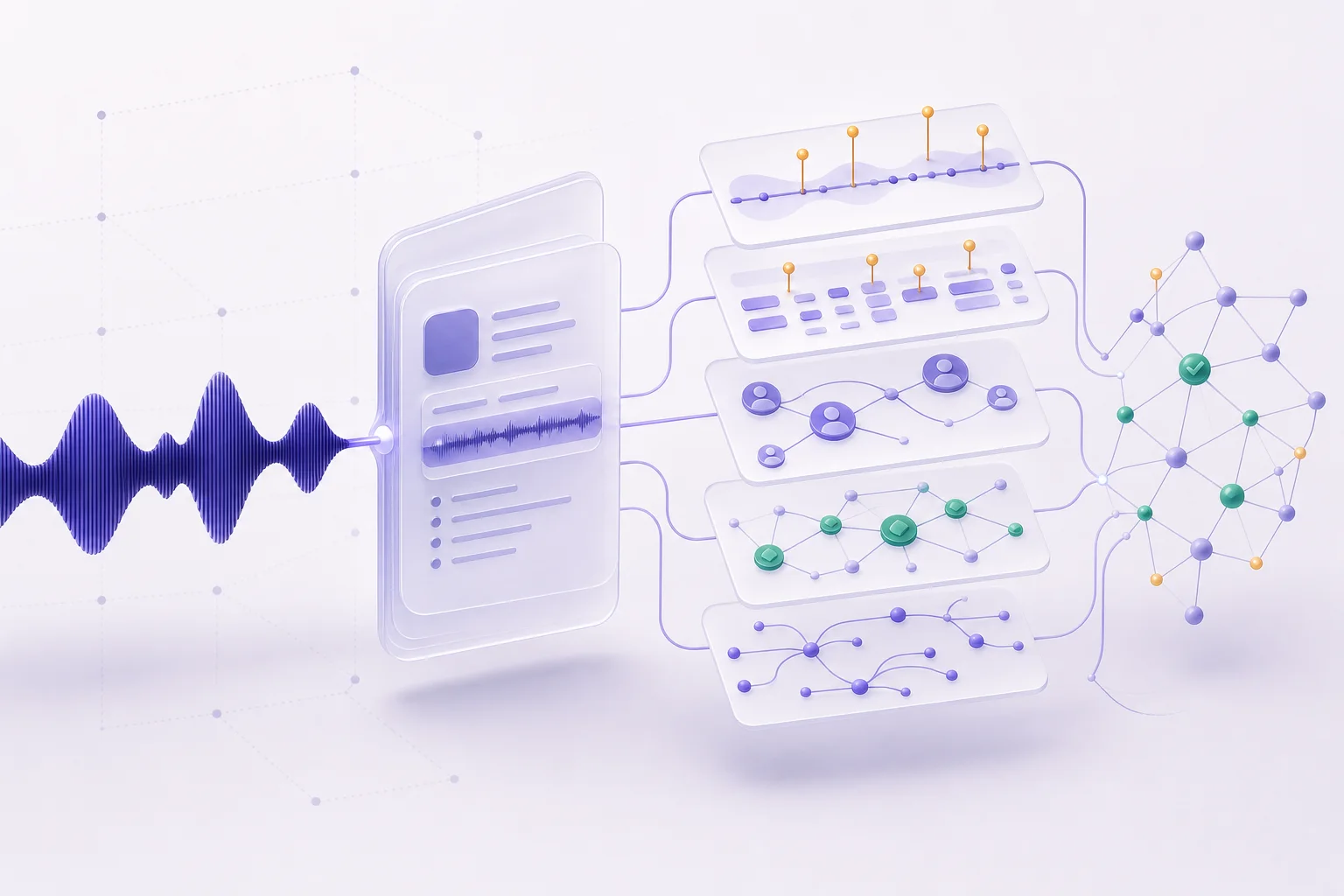
Every Channel has two separate machines. Sync keeps the catalog mirrored from the source. Indexing turns selected episodes into transcripts and structured Briefs. Sync is automatic and unmetered; indexing is an explicit publishing action funded by the Owner's Credits.
Seeing an episode in the Studio does not mean it is public. An episode first appears in the public Library after its first successful Index.
Source of truth
Each Channel connects to exactly one source:
- A YouTube channel, identified by its stable channel id.
- An RSS feed, identified by its podcast GUID when available, with the normalized feed URL as a fallback.
PodHood never writes back to that source. Episode titles, descriptions, publication dates, media, and source membership are mirrored facts; content operations such as renaming a YouTube video still happen on YouTube.
There is one current provider nuance: YouTube Channel metadata such as title and artwork is refreshed on sync. RSS episode data refreshes from the feed, but the Channel-level title/artwork captured at connection is not currently re-mirrored on every sync.
Sync — catalog mirroring
The scheduled sync has two cadences:
- Hourly light sync picks up the newest source items quickly.
- Daily full sync walks the complete YouTube catalog, reconciles deleted videos, and converges YouTube playlists into PodHood Collections. RSS sync reads the feed's current recent window.
Sync now in the Studio starts an on-demand full sync. It does not spend Credits and does not automatically Index anything.
Important behaviors:
- The source wins. The next sync picks up source-side episode changes.
- Deletions archive instead of destroying. A source item judged deleted leaves active Studio/Library views but its stored history is not hard-deleted.
- Removals can be kept instead. Settings → General → Keep removed episodes stops sync from archiving episodes that disappear from your source, and restores previously archived ones — for shows that hide episodes at the host but want them to stay on PodHood.
- Address drift is safe. Episode identity uses stable ids such as a YouTube video id or RSS GUID rather than a changing enclosure URL.
- Transcription creates a source download. An RSS host can record roughly one additional audio download the first time an episode is transcribed.
- Collections mirror YouTube playlists. Create, rename, reorder, or remove playlist membership on YouTube; the daily/full sync converges it in PodHood.
Indexing — publication and intelligence
Indexing processes one episode in this order:
- Reserve the estimated Credits from the Owner's pool.
- Fetch and transcribe the media with word-level timing.
- Derive the Brief: summary, chapters, key moments, Q&A, speakers, entities, and topics.
- Build the search index and publish the episode.
- Settle the hold to the measured duration.
The first successful run changes the episode to Live and publishes its Library page. A failed run returns its hold; a failed episode can be retried from the Studio.
Activation sample, backfill, and new episodes
These three cases look similar in the UI but have different intent:
| Case | What happens |
|---|---|
| Activation sample | The newest single episode is automatically Indexed at initial connection. It is unmetered and gives the Owner a first live Brief. |
| Backfill | Your team selects older episodes and Indexes them in batches. It uses the Owner's Credits at the normal rate. |
| New source episode | Scheduled Sync brings it into the Studio as unindexed. Your team chooses when to Index and publish it. |
For a first backfill, begin with a representative slice instead of clicking Index all immediately: recent flagship episodes, evergreen episodes with recurring questions, and episodes featuring important guests. Validate the output, then expand the batch.
If the Credit pool cannot fund the whole selection, PodHood queues the episodes it can cover in input order and reports the remainder. See Plans & credits.
Re-indexing
Re-index reruns the AI-derived Brief under the current pipeline and republishes the result. It reuses the existing Transcript, so it does not transcribe the media again, but the run still uses Credits for the new indexing work.
Use it when:
- An older episode predates a newer Brief field such as Q&A.
- Prompt/model improvements should refresh the structure.
- A prior run failed after transcription.
Human speaker/entity corrections are stored separately from the transcript blob and remain the authoritative presentation layer. A merged or archived entity also stays on the resolution ladder, so re-indexing should not recreate the duplicate as a fresh entity.
What does not spend Credits
The current Credit meter applies to Index and Re-index. These operations do not draw from the pool:
- Scheduled or manual Sync.
- The initial activation sample.
- Public/Studio Search and filtering.
- MCP and REST reads.
- Transcript Translation.
Current plan grants and rates are documented in Plans & credits and on the pricing page.
Common questions
Does PodHood replace my podcast host or website? No. It is a mirror, index, and public discovery surface. Your source and existing site remain in place.
Can I keep an imported episode private? Yes. Leave it unindexed. It stays visible to Channel Members in the Studio and absent from every public surface.
Can I unpublish a live episode without deleting it at the source? There is no separate publish toggle today. Public visibility follows successful Indexing and source archive state.
Can I remove an episode at my host but keep it on PodHood? Yes. Turn on Settings → General → Keep removed episodes. While it is on, an episode that disappears from your source feed stays published on PodHood, and enabling it restores episodes earlier syncs archived. Turn it off to return to the default, where the next sync re-archives source removals.
How quickly does a source change appear? Newest-item changes are normally picked up by the hourly sync. Full-catalog deletion/playlist reconciliation can take until the daily full sync unless a Member uses Sync now.
What language does the Library use? Settings → General → Podcast language is the fallback for source-language detection, the default for Transcript Translation, and the base Interface language for public pages.