Introducing PodHood: turn your podcast into a knowledge graph
Connect a channel once, and every episode becomes searchable, crawlable, citable, and queryable — for your listeners, for search engines, and for AI agents. Here's what PodHood does and why we built it.
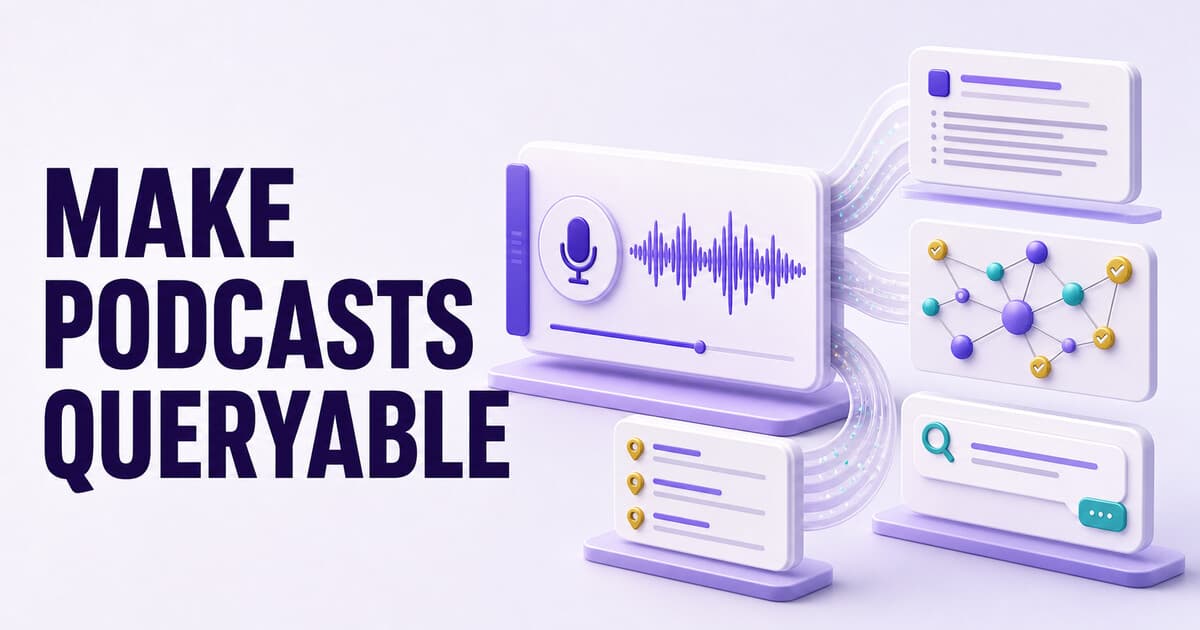
PodHood connects to your YouTube channel or podcast feed, mirrors your whole catalog, and decomposes every episode into a structured Brief — summary, chapters, key moments, speakers, entities, topics, and a word-level transcript. It publishes that as pages your listeners can search, search engines can crawl, answer engines can cite, and AI agents can query over MCP. Connect once; every new upload indexes itself.
We started PodHood because of a gap that kept bothering us: podcasting has never been more popular, and podcast content has never been harder to find. A great episode disappears the moment it's published — unsearchable, uncrawlable, uncitable. The work is invisible to the exact systems that now decide what gets discovered.
So we built the thing that fixes it. Here's what it does.
Connect once
Point PodHood at your YouTube channel or your podcast feed. That's the only setup. We treat that source as your single source of truth and mirror your whole catalog — every episode you've published, and every one you publish next.
Every episode becomes a Brief
Indexing decomposes each episode into a structured record we call a Brief:
- A grounded summary of what the episode covered.
- Chapters that segment the conversation.
- Key moments — the citable claims and turns worth linking straight to.
- Speakers, diarized and attributed.
- Entities and topics, disambiguated into a graph.
- A word-level transcript, aligned to the audio so any phrase jumps to the exact second.
That structure is the whole point. It's the difference between a recording and something people and machines can actually use.
Found four ways
Once an episode is a Brief, it gets discovered on four fronts at once:
- Searchable — your listeners find any moment by what was said, and jump straight to it.
- Crawlable — every episode is a real, server-rendered page that search engines can read and rank. (Why that matters: Podcast SEO.)
- Citable — the structure answer engines like ChatGPT and Perplexity quote as a source. (More: get cited by AI.)
- Queryable — your whole archive connects to Claude and ChatGPT as a live tool over MCP, so agents can query it and answer with timestamped citations.
And it runs itself
Connect once, and every new upload indexes on its own. Your back catalog and your next episode go through the same pipeline. You keep creating; PodHood keeps making it findable.
Where we are
This is day one. We're onboarding a small set of founding channels now. If you want your podcast to be the one people search and AI cites, connect your channel and see it come alive — or start with the product tour.
Frequently asked questions
- What does PodHood do?
- It turns a podcast into a structured, searchable library. Connect a YouTube channel or podcast feed and PodHood mirrors your catalog and indexes each episode into a Brief — summary, chapters, key moments, speakers, entities, topics, and a word-level transcript — then publishes it as pages built to be found and cited.
- What sources can PodHood connect to?
- A YouTube channel or an RSS/podcast feed. PodHood treats that as your single source of truth, mirrors the full archive, and keeps it in sync as you publish new episodes.
- Do I have to re-upload my back catalog?
- No. Connect once and PodHood imports your existing episodes, then automatically indexes every new one going forward — the same pipeline for your archive and your next release.
- How is this different from a transcription tool?
- Transcription is one input. PodHood is discoverability infrastructure: it builds a structured knowledge graph per episode and publishes it so your catalog is searchable by listeners, crawlable by Google, citable by answer engines, and queryable by AI agents over MCP.
Founder of PodHood. Writes about how podcasts and YouTube channels get found on Google and in AI answers — and turn that discovery into an audience they own.
Keep reading
- Does your podcast need its own website? Why one platform isn't enough
- WebMCP for podcasts and YouTube channels: now agent-ready