The machinery that gets you found.
PodHood decomposes every episode into structured data — then publishes it where people, search engines, and AI agents actually look. This page walks that pipeline end to end.
Connect once. Found everywhere.
From a channel link to a citable knowledge graph in five steps — then it runs itself.
Connect
Point PodHood at your YouTube channel or podcast feed. One source of truth per channel.
Sync
We mirror your catalog — every episode, past and future. The source always wins; you curate there, not here.
Index
Each episode is decomposed into its Brief: summary, chapters, key moments, speakers, entities, topics.
Publish
Every episode becomes a real, server-rendered page on your Library — text that search engines and AI can read.
Found & cited
People find you on Google; answer engines quote you; agents query your archive over MCP.
Anatomy of a Brief
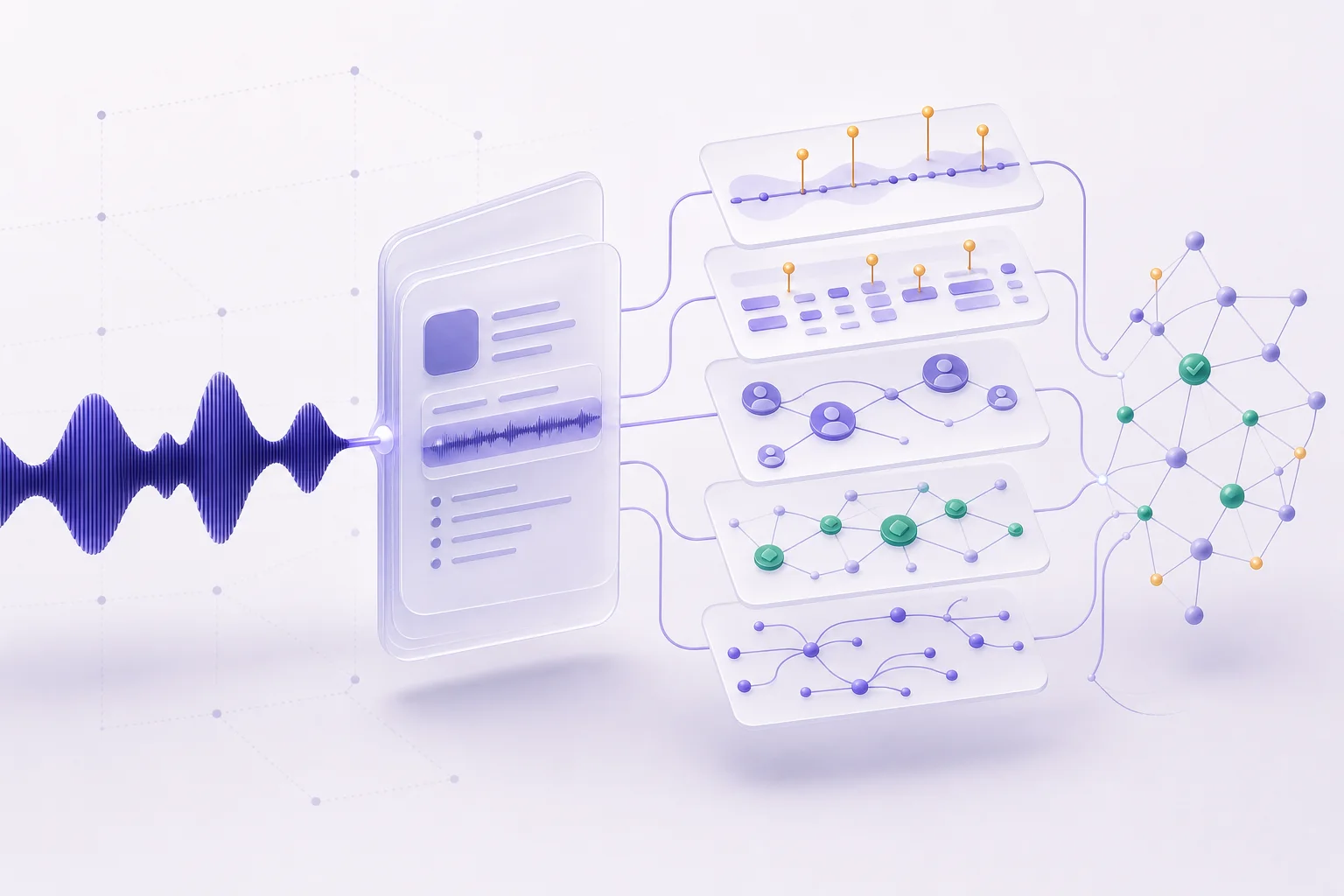
Indexing turns each episode into structured data — not a wall of transcript text, but a graph machines can read and cite.
- Summary
- A grounded abstract of the episode — what it covered, in the words an answer engine can quote.
- Chapters
- The episode segmented into navigable sections, each with its own timestamp and heading.
- Key moments
- The citable moments — claims, definitions, and turns worth linking straight to.
- Speakers
- Who said what, diarized and attributed across the whole conversation.
- Entities & topics
- A disambiguated graph of the people, companies, products, and topics in each episode.
- Word-level transcript
- The full transcript, aligned to the audio so any phrase jumps to the exact second.
Built like infrastructure
Discoverability isn't a one-time export. It's a pipeline that keeps your whole catalog live for people, search engines, and agents.
Auto-indexing
Your channel is checked hourly for new episodes; each one is indexed on its own — set it once and every upload joins the library.
Custom domain
Host your Library on your own domain, optionally white-labeled — your brand, your address.
MCP endpoint
Your archive is a live tool for Claude and ChatGPT over MCP — agents query it and answer with citations.
Access Analytics
See who finds you: library visitors, the links and AI answers that sent them, and the questions AI agents ask your catalog. On every plan.
Comment insights
YouTube comments mirrored read-only, labeled by sentiment and intent in any language, and clustered into what to make next.
AI clips
A video presence for audio-only shows: key moments become captioned vertical clips built for Shorts, Reels, and TikTok — no camera, no editor. Included on every plan.
Email subscribers
Listeners subscribe on your Library in one click, and every new episode automatically emails them its brief — an audience you own, on every plan.
How is a Brief different from a transcript?
A transcript is text without structure — one long wall of words. A Brief is the episode decomposed into parts machines can actually use: a grounded summary, chapters, key moments, diarized speakers, entities, topics, and the transcript itself, word-aligned to the audio.
That difference is why the same content ranks and gets cited as a Brief when it never did as a transcript. Search engines and answer engines reward structure they can parse, link, and quote — a heading to anchor on, a timestamp to deep-link, an entity to disambiguate.
Why does one structure feed every surface?
Because discoverability problems are all the same problem: audio has no machine-readable text. Solve it once — decompose the episode into a Brief — and the pages Google crawls, the search listeners use, the answers agents cite, and the clips that feed short-form are all views over the same structure.
That is also why the pipeline runs itself: when a new episode lands, one indexing pass updates every surface at once. There is no separate SEO export, search index, or clip project to maintain.
Frequently asked questions
PodHood turns a podcast or YouTube channel into a searchable website — a page for every episode, built to be found on Google and cited in AI answers, with an email list you own. Connect your YouTube channel or podcast RSS feed once: every episode is decomposed into a structured Brief — summary, chapters, key moments, speakers, and a word-level transcript — and published as a page, with a live MCP endpoint AI agents can query and a Subscribe button on every page.
A YouTube channel or a podcast RSS feed — one source of truth per channel. PodHood mirrors it completely: every episode, past and future, with the source always winning on curation.
The structured decomposition of one episode: a grounded summary, chapters, key moments, diarized speakers, a disambiguated graph of entities and topics, and a word-level transcript aligned to the audio. Everything PodHood publishes — pages, search, citations, clips — is built from it.
No. Your host, feed, and channel stay exactly as they are. PodHood sits alongside them as the discoverability layer — it reads your published catalog and builds the text surfaces your audio can’t provide.
None after connecting. Your channel is checked hourly; new episodes are indexed and published on their own. You keep curating in your source channel, and the Library follows.
You can fix it. Studio includes curation tools: identify or correct diarized speakers inline, rename entities without losing their aliases, merge duplicates, archive noise, and regenerate the topic taxonomy. Corrections flow through to the published pages and the graph.
Yes — Clips gives an audio-only show a video presence. Each indexed episode's key moments appear as ready-made candidates in the Studio, and every clip renders as a vertical 1080×1920 video with animated captions burned in — trimmed on the transcript, styled from 11 templates and 17 caption styles, ready for Shorts, Reels, and TikTok. Included on every plan; rendering never draws from indexing credits. Live for RSS-sourced channels; YouTube-sourced channels are next.
Yes. Visitors can subscribe to your Library and get a branded new-episode email — summary, chapters, and key moments, deep-linked to your domain — with one-click unsubscribe built in.
Yes — custom domains are included on every plan. The Library keeps PodHood branding unless you use Studio white-label on the verified domain.
Grow from episodes you’ve already made.
Connect a YouTube channel or podcast feed — your back catalog imports in minutes, and every episode becomes another way for new listeners to find you. Free to start — no credit card.
Get started