Podcast monetization strategies: what actually works in 2026
The reliable ways to monetize a podcast in 2026 — real CPM ranges, membership math for small engaged shows, and how successful podcasters stack multiple revenue streams. With the numbers, not the hype.
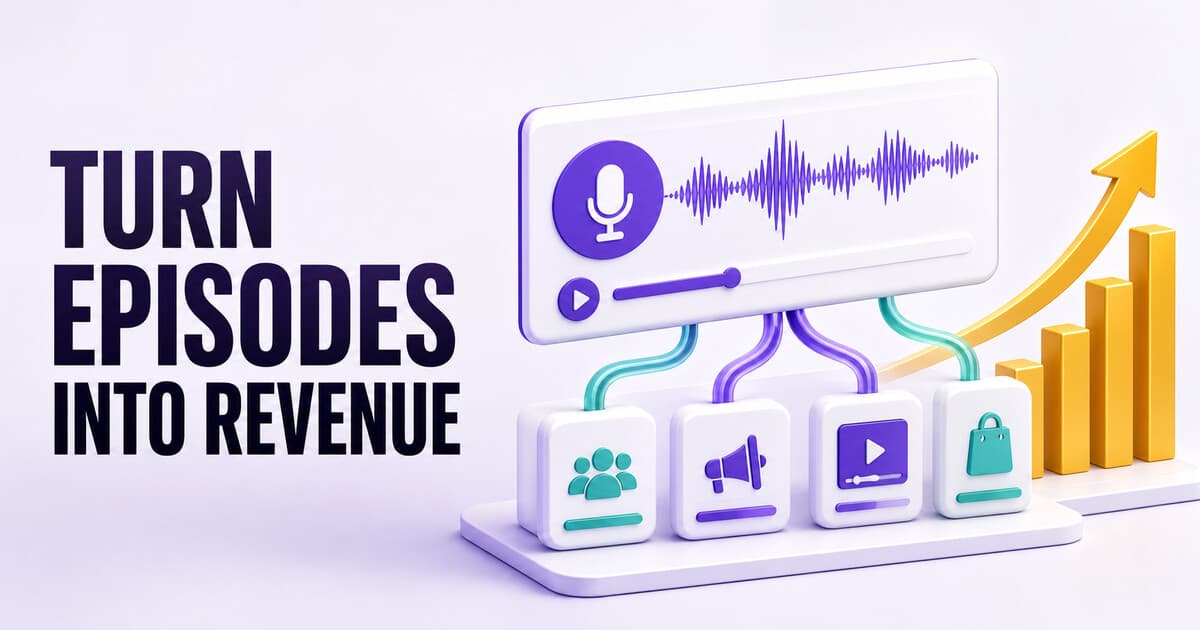
No single stream is 'the best' — the reliable pattern in 2026 is a stack. Ads pay at scale (host-read mid-rolls run ~$20–50 CPM, but agencies want 10k+ downloads per episode); memberships pay at any scale (1–5% of loyal listeners convert, so 1,000 true fans can out-earn CPM math immediately); affiliate, premium content, video, live events, and services layer on top. Sequence by stage: direct support first, premium content as you grow, sponsorships once the numbers clear. And every one of these streams prices off audience — which makes discoverability the upstream multiplier.
Podcast monetization advice usually fails in one of two directions: it either assumes you have 50,000 downloads per episode, or it hand-waves past the numbers entirely. This guide does neither. Here's what each strategy actually pays in 2026, what audience size it starts working at, and how the shows that earn real money combine them.
The 2026 landscape, in numbers
Podcast money is real and still growing. US podcast ad revenue reached $2.86 billion in 2025, up 17.6% year over year (IAB/PwC), and counting subscriptions, programmatic, and video, one industry study put total US podcast revenue at nearly double the ad-only figure (Owl & Co. via Radio Ink). On the listener side, 55% of Americans 12+ now listen monthly (Edison Research, Infinite Dial 2025).
Two structural shifts define 2026. Video became the default — about 71% of US podcast creators now produce video versions, and 72% of new listeners discover shows through video first (Radio Ink, Edison via PodcastVideos). And direct listener revenue went mainstream: podcasters earned $629 million on Patreon alone in 2025, up 33%, making podcasting Patreon's largest category (Variety).
The strategies at a glance
| Typical numbers (2026) | Starts working at | |
|---|---|---|
| Memberships / paid subs | 1–5% of loyal listeners convert, ~$5–15/mo | Any size — engagement matters |
| Sponsorships (ads) | $15–30 CPM pre-roll, $20–50 CPM host-read mid-roll | ~2k–5k direct; 10k+ agencies |
| Affiliate marketing | 10–30% commission per referred sale | Any size, niche shows excel |
| Premium / bonus content | Ad-free feeds, extra episodes, early access | A few hundred true fans |
| Video (YouTube/Spotify) | 55% ad share on YouTube; Spotify thresholds cut | ~1k subs / 1k engaged listeners |
| Live events | $15–50 standard tickets, $100–250 VIP | Established, local-dense fans |
| Courses & services | Your back catalog as proof of expertise | B2B / education niches |
The rest of this post walks through each — and then the part most guides skip: how to combine them, and what makes all of them grow.
Sponsorships: the scale game
Host-read ads remain podcasting's premium format: listeners are 81% more likely to act on a host-read ad than a pre-produced spot, and 76% of weekly podcast listeners have taken action after hearing podcast ads (Hashmeta, Digital Applied).
The rates in 2026: $15–30 CPM for pre-rolls, $20–50 for host-read mid-rolls, with niche B2B and finance shows commanding $50+ (Million Podcasts, Transistor). CPM means per thousand downloads — which is exactly the catch. Ad agencies and large marketplaces generally want 10,000–20,000 downloads per episode; direct outreach to niche advertisers works from about 2,000–5,000 (The Podcast Haven). Meanwhile 80% of all episodes get fewer than 1,300 downloads in their first 30 days (Transistor).
So treat ads as a stream you grow into, not the starting point. If you're under those thresholds, the next section is where your money is.
Memberships: the engagement game
Direct support inverts the ad math: it pays on engagement, not scale. The consistent benchmark across platforms is that 1–5% of loyal listeners will convert to paid (Supercast), and 38% of podcast listeners say they'd happily pay to support favorite shows (Ofcom via Podrewind).
Run the numbers for a small show — 1,000 loyal listeners:
- Ads: 1,000 downloads × $25 CPM mid-roll ≈ $25 per episode.
- Membership: 1,000 listeners × 3% conversion × $7/month ≈ $210/month, recurring, before you publish anything.
That's why "grow first, monetize later" is backwards for small engaged shows. The audience you have is already monetizable — if the offer is direct.
What you're charging for is simple: ad-free feeds, bonus episodes, early access, community, Q&A. Keep it to two or three benefits, offer an annual plan (annual and lifetime tiers outperformed monthly in 2025), and mention the support link in-episode — shows that do convert 3–4x better than those that don't (Transistor).
One caution before you promise bonus episodes: most membership benefits are really a second production schedule. Every "weekly bonus episode" perk is a permanent content commitment on top of your main show — the quiet reason so many paid tiers stall. The best benefits are ones your existing work already pays for: ad-free listening, your archive, early access. Hold that thought — it matters at the end of this post.
The platform fees, since they compound forever: Patreon takes 10% for creators who joined after August 2025 (Patreon); Substack takes 10% (Substack); Apple Podcasts Subscriptions takes 30% in a subscriber's first year, 15% after, plus a $19.99/year program fee (Apple); Supercast charges a flat $0.59/subscriber/month (Supercast). At a few hundred subscribers, the difference between a percentage cut and a flat fee is real money every month — remember that number; we'll come back to it.
Affiliate, premium content, and products
Affiliate marketing is the underrated small-show stream: commissions typically run 10–30% of each referred sale (SaaS often recurring), and it monetizes the same trust that makes host-read ads outperform — with no minimum download threshold (ReferralCandy).
Premium content overlaps with memberships but deserves its own line: subscriber-only episodes, extended interviews, and archives you paywall. Substack's own pitch is honest about the scale: a few hundred paid subscribers at $5/month replaces a meaningful income stream (Substack).
Courses, services, and consulting convert your back catalog into proof of expertise — the highest-ticket path for B2B and education shows. Merch and live events reward big, dense audiences: the podcast live-events market hit $1.2 billion in 2025 (Market Intelo), but they're late-stage streams, not first ones.
Video: the fastest-moving line
If you produce video, two programs matter. YouTube's Partner Program shares 55% of ad revenue with creators from 1,000 subscribers and 4,000 watch hours (YouTube). And Spotify slashed its Partner Program thresholds in January 2026 — down to 3 published episodes, 2,000 consumption hours, and 1,000 engaged listeners in 30 days (Digital Music News) — after paying creators over $100M in Q1 2025 alone (Spotify).
With 72% of new listeners discovering shows through video first, clipping your episodes for video platforms isn't a nice-to-have — it's the top of your monetization funnel. (This is exactly what PodHood clips automates: the key moments already identified in each episode, rendered as captioned vertical clips — the full workflow is in how to turn podcast episodes into video clips.)
How to stack streams: the workflow
The shows earning real money almost never run one stream. Independents making $2,000–8,000/month typically combine ads, memberships, and services (Command Your Brand); at the top end, Crime Junkie's ~$6M/year spans ads, tours, merch, and a fan club (Talks). The commonly recommended portfolio is three to five complementary streams (Podrewind).
The sequencing that works:
- From episode one: direct support (membership or tip jar) + one affiliate offer that genuinely fits your niche. Zero thresholds, pure engagement.
- From a few hundred true fans: premium content — a paid tier with bonus episodes or ad-free listening. This is where recurring revenue starts compounding.
- From ~2,000–5,000 downloads/episode: direct sponsor outreach to niche advertisers. Charge on engagement data, not just downloads.
- From ~10,000+: agencies, programmatic, dynamic ad insertion — ads become your biggest line.
- Whenever the fit is right: video monetization, courses, services, live events — matched to your content type, not your ego.
Each stream also feeds the others: a sponsor reads better on a show with visible community; members buy tickets; video clips recruit the listeners every other stream prices off.
The multiplier under every stream: discoverability
Look back at every number in this post — CPMs are per thousand downloads; agency minimums, Spotify's thresholds, membership conversion — every stream prices off how many people can find you. Monetization advice that skips discoverability is telling you how to sell a house without an address.
And discovery has changed. Around 40% of listeners find shows via in-app search, and AI answer engines — ChatGPT, Perplexity, Google's AI Overviews — increasingly decide what gets recommended (Priori Data). Those systems can't hear audio. Without readable text and structure, your episodes are invisible to the exact systems now routing new listeners (why that is, and how to get cited by AI).
That's the layer PodHood handles. Connect your YouTube channel or RSS feed once, and every episode — the whole back catalog, and every new upload automatically — becomes a structured Brief: summary, chapters, key moments, speakers, entities, and a word-level transcript. That structure publishes as four surfaces at once:
- Searchable — listeners find any moment by what was said and jump to the exact second.
- Crawlable — real, server-rendered episode pages Google can rank.
- Citable — the structure answer engines quote as a source (SEO and GEO from one fix).
- Queryable — your archive as a live MCP endpoint that ChatGPT and Claude can query with timestamped citations.
Plus the clips that feed video-first discovery. One pipeline, every discovery surface — and every monetization stream above compounds on top of it.
What's next: monetization built into your library
Here's the part we're most excited about. Today PodHood makes your catalog discoverable. Next, we're making it monetizable — directly.
We're building paid subscriptions into the PodHood library — think Substack, but for your whole podcast catalog. And it's designed around the trap we flagged in the memberships section: benefits that don't put you on a second production schedule. Monetize your archive, not your extra labor. On your library page, listeners become paying subscribers, and the paid tier is built from value your existing episodes already contain:
- Premium access to the library itself — the features your superfans already use, as paid perks that cost you zero additional production: deep search across your full catalog, and your MCP endpoint, so a paying subscriber's AI assistant can query your entire archive as a private research tool. For B2B, education, and research-heavy shows, that's a perk no bonus episode can match.
- Premium content, when you want it — subscriber-only episodes, early access, and paywalled sections of your archive, with free previews generated from each episode's key moments.
- An owned audience — your subscribers, on your domain, on your list. Not an algorithm's. Free email subscriptions are already live: listeners subscribe on your library, and every new episode emails them its brief automatically.
And because monetization sits inside the library rather than on a separate platform, the conversion moment is built in: when a listener searches your archive and lands on premium content, that's the highest-intent instant a fan ever has — and exactly where the subscribe prompt appears.
The economics follow the fee math above: flat, predictable pricing — not a percentage cut of your subscription revenue. But the fee is the supporting act; the headline is a paid tier your back catalog funds by itself.
If you want your show on that rail early, connect your channel — founding channels get first access as these features roll out. The discoverability layer is live today; the audience it builds is the one you'll monetize next.
Frequently asked questions
- What is the most reliable way to monetize a podcast in 2026?
- A stack, not a single stream. For most shows the most reliable base is direct listener support (memberships or paid subscriptions), because it works at any audience size and isn't gated by advertiser minimums. Ads become the larger line once you consistently clear several thousand downloads per episode. Successful independents typically combine three to five streams.
- How many downloads do I need to get podcast sponsors?
- Most ad agencies and large marketplaces want 10,000–20,000 downloads per episode within 30 days. Direct outreach to niche advertisers works from roughly 2,000–5,000, and some marketplaces accept shows from about 500 downloads. Below those numbers, direct listener support usually earns more than ads.
- How do small podcasts with engaged audiences make money?
- Through direct support, where engagement beats scale. Typically 1–5% of loyal listeners convert to a paid membership. A show with 1,000 loyal listeners converting 3% at $7/month earns about $210/month recurring — versus roughly $25 per episode from a mid-roll ad at the same audience size.
- What membership benefits should a podcast offer?
- Two or three benefits, no more — and prefer ones that don't create a second production schedule. Ad-free listening, early access, and access to your full archive are funded by work you've already done; a weekly bonus episode is a permanent new content commitment. Offer an annual plan (annual and lifetime tiers outperformed monthly in 2025) and mention the membership in-episode, which converts 3–4x better than passive promotion.
- Should I combine multiple podcast monetization streams?
- Yes — diversification is the strongest pattern in the data. Independents earning $2,000–8,000/month almost always combine ads, memberships, and services or products rather than relying on one stream. Start with the stream that fits your stage, then add complementary ones; three to five is the commonly recommended portfolio.
Building PodHood — turning podcasts into structured libraries that people find, search engines rank, and AI agents cite.
Keep reading
- WebMCP for podcasts and YouTube channels: now agent-ready
- How to turn podcast episodes into video clips (no camera required)