Does your podcast need its own website? Why one platform isn't enough
Spotify, Apple, and YouTube distribute your show; they don't build its authority. Why a podcast needs its own website in the AI era — evidence and a checklist.
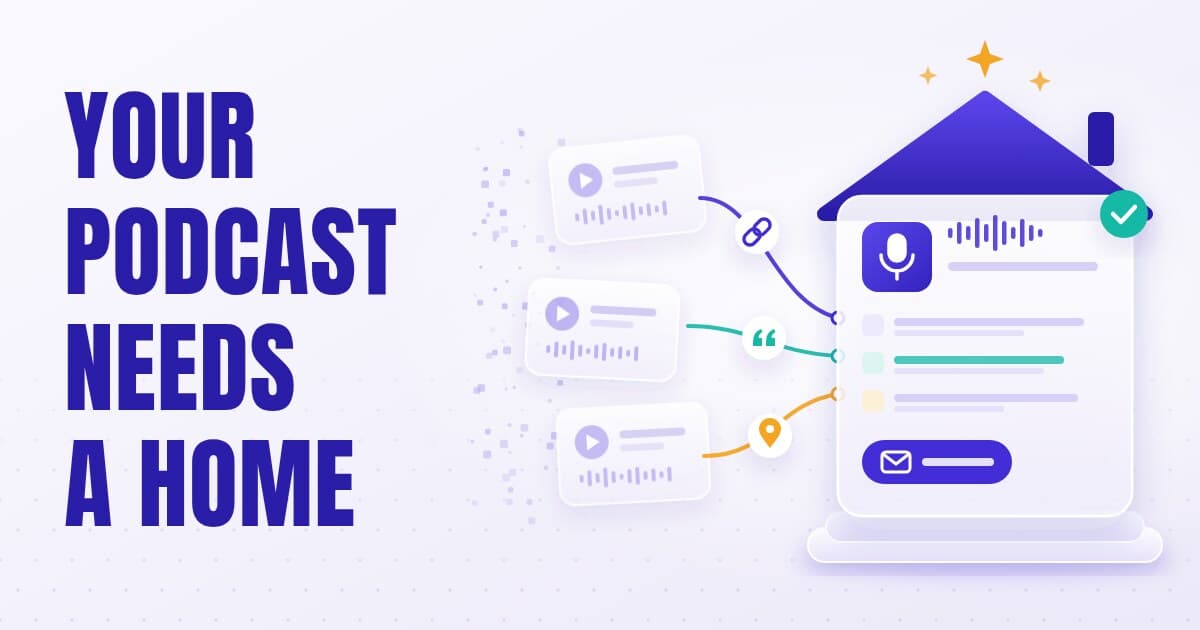
Yes. A podcast doesn't need its own website to publish, but it needs one to be found outside the apps and to keep what that discovery earns. Spotify, Apple, and YouTube distribute episodes; they don't build your show's authority on the open web. Answer engines each draw on different sources (YouTube is 29.5% of Google AI Overview citations but 0.2% of ChatGPT's), retrieval changes have cut a whole platform's citations within weeks, and the signal most tied to AI visibility — your name mentioned across the web — needs one permanent home to resolve to. A podcast website that compounds has an address you own, a real text page per episode, one show description used verbatim everywhere, dated pages kept fresh, and an email signup that turns visitors into an audience you own.
Ask a podcaster where their show lives and you'll usually get a list: Apple, Spotify, YouTube. Those are where it's distributed. Few shows have a place where it lives — one address that's theirs, that every link points to, and that keeps working whatever any single platform decides next. The platforms never offered that layer, so most shows never built it.
That used to be a nice-to-have. Now it decides whether a show compounds or rents: discovery has moved into Google results and AI answers, and the evidence on how those engines choose sources points one way — toward a stable, readable, consistently named home on the open web, not a profile page inside someone else's app. Here's the evidence, the five things that home has to do, and how to set one up without becoming a web team.
Do you still need a podcast website if you're on Spotify and Apple?
You don't need a website to publish a podcast; you need one to be found outside the apps and to keep what that discovery earns. Apple, Spotify, and YouTube are good at distribution — they're where existing fans press play. They're weak at three jobs a growing show depends on:
- Being found by people who aren't looking for a podcast. Someone searching a guest's name, a company, or a question your episode answered goes to Google or asks an AI assistant. An app's episode page — title, artwork, a paragraph of notes — gives those engines almost nothing to match.
- Being one recognizable entity. Your show has a different URL on every platform, so links, mentions, and guest shout-outs scatter across all of them.
- Owning the relationship. Platforms show you counts, not people. You can't email a follower, and an algorithm decides how many of them see each episode.
The honest objection: most listeners find new shows inside the apps — in The Podcast Host's 2024 survey of 166 listeners, only 11% would start with a search engine (The Podcast Host). That's the point: a website is for everyone the in-app path never reaches.
How do AI answers change podcast discovery?
Each answer engine draws on a different slice of the web, so a show that lives on one platform is visible to one engine at best. The divergence is large and measured:
- YouTube accounts for 29.5% of Google AI Overview citations but 0.2% of ChatGPT's (BrightEdge). A YouTube-only show can be well represented in one engine and nearly absent from another.
- ChatGPT, Google AI Overviews, and AI Mode disagreed on brand recommendations for 61.9% of identical queries (BrightEdge).
- Claude's web search tracks Brave far more closely than Google: 87.8% of the URLs it retrieved also sat in Brave's top 10, against 45.6% in Google's (Complete SEO). Ranking on Google alone doesn't cover every assistant.
And audio is invisible to all of them: the hour of conversation behind an app's episode page isn't text any engine can read. The questions your episodes answered are being answered right now, by AI, citing someone else. (How to get your podcast cited by ChatGPT covers the mechanics.)
Can a platform's AI visibility disappear overnight?
Yes — it has happened to the largest platforms on the web, for reasons that had nothing to do with their content. Two documented drops:
- In 2025, the share of ChatGPT responses citing Reddit fell from close to 60% in early August to around 10% by mid-September, and Wikipedia from roughly 55% to under 20% (Semrush). Perplexity and AI Mode barely moved, so the cause was ChatGPT's retrieval pipeline, not Reddit's posts.
- In August 2026 it happened again: Reddit's share of ChatGPT citations fell from a steady 3.8% to an average of 0.5% in about a week (Semrush).
Churn is normal, too: comparing June and July 2025, Profound found 54.1% of the domains cited in ChatGPT's answers hadn't been cited the month before (Profound). Yet some sources hold: in Google AI Mode, Sistrix found 86.5% of prompts kept a stable core of one to five domains for weeks and months (Sistrix).
If your visibility depends on one platform's standing with one engine, a pipeline change you'll never hear about can reset it. The durable position is to be one of the few sources an engine keeps returning to for your niche's questions — and that takes a home you control.
What makes AI trust a podcast: followers or mentions?
What AI engines reward looks less like follower counts and more like being talked about, by name, across the web. In Ahrefs' study of 75,000 brands, branded web mentions correlated with AI Overview visibility at 0.664, backlinks at just 0.218 (Ahrefs); a follow-up found YouTube mentions stronger still, at about 0.737 (Ahrefs). Earned media — coverage others chose to write — has made up 82–89% of AI citations since July 2025, paid placements 0.3% (Muck Rack). Correlations, not proof of cause, but they point the same way.
Software has a name for the trap: GitHub stars, which measure attention, can be bought, and make nobody depend on you. A platform follower count is the same kind of number. What compounds is being used — quoted, linked, recommended, cited.
Podcasts earn mentions naturally — guests promote their episodes, listeners quote moments — but a mention builds authority only if it resolves to one entity. When half your mentions link to Spotify, a third to YouTube, and the rest to nothing, no engine can tell they're the same show. A website gives every mention one address, and its structured data ties your profiles together with sameAs links, the disambiguation engines use to decide which show a name means.
Platform page vs podcast website: what's the difference?
A platform page is a URL inside someone else's app; a website is one address you own — and a structured one also makes every episode readable. Here's what each setup gives a show:
| Platform pages only | Basic podcast website | Structured home base | |
|---|---|---|---|
| What Google and AI can read | Title and show notes | Show notes, sometimes transcript | Summary, chapters, key moments, and transcript per episode |
| One address for every mention | No — one URL per platform | Yes | Yes, plus sameAs links to your profiles |
| Survives a platform or ranking change | No | Yes | Yes |
| Who your audience is | Counts only | Via a separate email tool | Built-in subscriber list |
| Reach every subscriber on release | The algorithm decides | If you wire RSS to email | Automatic new-episode email |
| Gets stronger as the catalog grows | For the platform | Slowly | Every episode adds citable pages |
Most of the benefit starts with one permanent address; the structured version turns a back catalog into hundreds of pages that can each answer someone's question.
What should a podcast website include in 2026?
Five things, roughly in the order they compound:
- An address you own, permanently. A domain or a subdomain like
library.yourshow.comthat will never change. Every link, mention, and citation accrues to it; moving resets the clock. - A real text page for every episode. Not a player and two lines of notes — a summary, chapters, key moments phrased as standalone claims, named speakers, and a transcript. Engines retrieve passage by passage, so each moment should make sense lifted alone. (Why episodes stay invisible without this.)
- One description of the show, used verbatim everywhere. One sentence — what the show covers, for whom, who hosts it — pasted unchanged into your site, Apple, Spotify, YouTube, and every guest brief. Models learn which names go with which topics through repetition; three taglines split one association into three weak ones.
- Dates, and pages kept fresh. Dated episode pages are a track record no newcomer can backfill. Keep evergreen pages current, too: in AirOps' analysis of ChatGPT-cited pages, those not updated in over a year were more than twice as likely to lose their citations (AirOps).
- A way to own the relationship. An email signup on every page, so a visitor who arrives from a citation becomes a subscriber who hears about every future episode. (How to build a podcast email list.)
What you can skip: llms.txt as a growth lever. Adoption grew 8.8x in a year (Originality.ai), yet Ahrefs found 97% of sites with a valid file got zero requests for it in May 2026 (Ahrefs), and Google says such files neither help nor hurt Search visibility (Google). Keep one if your platform generates it; don't expect it to move anything. Skip mass-produced "SEO articles" about your episodes for the same reason — generic content stands out nowhere, and your conversations are original by definition. Publish them.
Is being cited by AI enough?
No — authority that isn't tied to a relationship you own gets absorbed by the answer. Software has the cautionary tale here too. In January 2026, Tailwind CSS's creator reported docs traffic down about 40% since early 2023 and revenue down close to 80% — while the framework was "growing faster than it ever has" (Tailwind Labs). AI tools absorbed the knowledge and stopped sending the visit.
A podcast faces the same risk: an AI answer can paraphrase what your guest said in episode 87 without anyone hearing it. A citation puts your name and a link next to the answer, but only your own site can turn that link into something that lasts — a page worth exploring and a subscribe button. The chain to build is cited → found → owned → compounding, and every link after "cited" happens on your site, not the platform's.
How do you build a podcast website without a web team?
Connect your show once and let the site build itself — this is the step PodHood exists for. Connect your podcast's RSS feed or YouTube channel and PodHood publishes a library: a searchable website for your show, on a podhood.com subdomain or your own domain, on every plan.
- A page for every episode, server-rendered for crawlers: summary, chapters, key moments deep-linked to the second, named speakers, and a word-level transcript — plus Schema.org markup for the show, its episodes, and its people, with
sameAslinks to the show's public profiles. - New episodes index themselves as they publish. Your host and feed don't change.
- Subscribe on every page, with an automatic new-episode email to your list, sent under your show's name.
- Access Analytics that separate people arriving from Google and AI answers from AI agents querying your catalog — receipts, not promises.
- An MCP endpoint, so AI assistants can search your episodes live and cite the exact moment.
Keep publishing to Apple, Spotify, and YouTube — the library is the home they all point back to. Running a YouTube talk channel? The same approach covers your channel. Who this isn't for: daily news recaps, narrated articles whose text already exists, and music or montage content — a home base compounds when episodes hold knowledge people go looking for.
Your part: a 30-minute consistency pass
- Write the one-sentence description of your show and paste it verbatim into Apple, Spotify, YouTube, your site, and your guest brief.
- Point every link you control at your domain — bio links, show notes, guest kits, newsletter footers — not at an app.
- Ask guests to link their episode's page on your site when they share it. A link from a guest's own site is a mention you couldn't buy.
- Say the address on air. "Everything's at yourshow.com — subscribe there" offers something "like and subscribe" can't.
- Monthly, ask ChatGPT, Perplexity, and Google the five questions your best episodes answer, and note per engine whether your show appears. One check proves little; a year of them shows whether your home is working.
The platforms will keep changing what they show, and to whom. A home on the open web is the one part of your show's discovery that changes only when you change it.
Start with how PodHood works, go deeper on podcast SEO, or read GEO vs SEO for podcasts for how the two kinds of search fit together.
Frequently asked questions
- Do I need a podcast website if I'm already on Spotify, Apple Podcasts, and YouTube?
- You don't need one to publish — the apps handle distribution well. You need one to be found outside them and to own the relationship: an episode page Google can index and an AI answer can cite, one address every mention points to, and an email signup no app offers. Keep the platforms; make your site the home they all link back to.
- Isn't my podcast host's free website enough?
- It's a good start if it runs on a domain you control and gives every episode its own page. The usual gap is depth: most host sites publish a player and show notes, not the conversation as readable text, so the answers inside your episodes stay invisible to search and AI. Check whether each episode page carries a transcript, chapters, and quotable key moments — and whether visitors can subscribe by email.
- What should a podcast website include?
- Five things: an address you own permanently (a domain or subdomain), a real text page per episode with a summary, chapters, key moments, and a transcript, one show description used verbatim on every platform, dated pages kept fresh, and an email signup on every page. A player and show notes alone give search engines and AI answers almost nothing to read.
- Will a website get my podcast cited by ChatGPT?
- No website can guarantee a citation — engines choose sources per question, and their mix changes month to month. What a website does is make you eligible: answer engines can only cite text they can retrieve, so a structured page per episode puts your answers in the running, where audio alone never is. Measure it with AI referrals in your analytics, not promises.
- Does llms.txt help my podcast get found by AI?
- Not much on its own. Ahrefs found that 97% of sites with a valid llms.txt file got zero requests for it in May 2026, and Google says the file neither helps nor hurts Search visibility. It's a harmless index for the agents that look for it; the pages themselves — readable, structured, linked — are what engines retrieve and cite.
- Most of my listeners find me inside Apple or Spotify — why bother?
- Because the website reaches people the apps never will. In The Podcast Host's 2024 survey, only 11% of listeners said they'd start with a search engine to find a new show — but someone searching a guest, a company, or a question isn't looking for a podcast at all. Your website is how the answer inside episode 87 reaches them.
- Do I have to leave my podcast host to use PodHood?
- No. PodHood reads your public RSS feed or YouTube channel and builds the website from it. Your host, your feed, and your platform listings stay exactly as they are.
Founder of PodHood. Writes about how podcasts and YouTube channels get found on Google and in AI answers — and turn that discovery into an audience they own.
Keep reading
- WebMCP for podcasts and YouTube channels: now agent-ready
- How to turn podcast episodes into video clips (no camera required)